
Indoor Air Quality (IAQ) Guidance During Covid-19 Pandemic

People’s lifestyles and perspectives of their surroundings have altered as a result of the COVID-19 epidemic. The term “public space” refers to areas to which the public has unlimited access and right of way. COVID-19 is transferred mainly by close contact and respiratory droplets generated when an infected person coughs, sneezes, speaks, or sings. In some circumstances, such as enclosed spaces with little ventilation, it can also be transmitted by virus aerosols in the air. As a result, mitigating this risk requires enhancing indoor ventilation and air quality. The Department of Occupational Safety and Health has issued recommendations for improving ventilation and indoor air quality (IAQ) in public locations during the COVID-19 epidemic. This guidance is based on the Department of Health and Human Services’ 2010 Industry Code of Practice for Indoor Air Quality, as well as other established documents on ventilation and indoor air quality published by respective international organisations and other countries during the COVID-19 pandemic. It is applicable to structures equipped with a mechanical ventilating and air conditioning (MVAC) system, an air conditioning system that does not deliver fresh air, or natural ventilation. This recommendation represents one of the best practises that people concerned in preventing COVID-19 viral transmission by airborne. Filtration Engineering Controls Filtration of recirculated air throughout the building to remove aerosol particles (extremely small particles bearing the virus) as feasible. Enhancing air filtration may include upgrading HVAC filters to MERV 13 (or the greatest MERV rating that the building’s ventilation system can support) and installing portable air cleaners in places that are difficult to ventilate with outside air or have a high density or occupancy. Minimize virus transmission between people through indoor airborne transmission. This may include venting all restrooms directly to the outside and rerouting airflows to avoid blowing directly from person to person, if possible. Increase Outside-Air Ventilation Increase Air Filtration Adjust/ Re-Configure Air Flows measures for air-conditioned premises (Indoor Air Quality) All occupied space must be adequately ventilated by the MVAC system: (a) Daily inspections of the Air Handling Unit (AHU) are required to ensure indoor air quality maintained. (b) All supply air diffusers shall function in the direction of the intended air flow. (c) Maintain the MVAC system on a regular basis by inspecting and cleaning the supply and exhaust fans, as well as inspecting and cleaning the air ducts and dampers for leaks or blockages. (d) ICOP IAQ 2010 specifies recommended maintenance intervals and PPE should be worn appropriately throughout any maintenance job. (f) Ascertain that no air is leaking into any occupied space. This includes water seals, pipe or duct cracks, and wall gaps. Any issue that arises should be resolved immediately. Determine that the AHU and Fan Coil Unit (FCU) are operating at full speed and capacity with all air dampers fully opened: (a) Turn off the demand control system that regulates the reduction of outdoor fresh air delivery. (b) To ensure optimal entrance of outdoor fresh air, all air dampers should be opened and no air ducts should be blocked. (c) Ensure that all outdoor air reaches its proper destination by balancing the air distribution system. (d) Exhaust fans run at maximum capacity in order to exhaust air from enclosed places. (f) Close windows and other openings near exhaust fans to prevent air flow from being shorted out. If the existing system does not provide adequate external air, a supply and/or exhaust fan should be added. Let say the MVAC system does not meet the necessary operational requirement, the maximum room occupancy should be decreased. (g) The recirculation air dampers should be set to the lowest setting possible. High-efficiency filters should be used to handle recirculated air (at least MERV13 is recommended). Filter maintenance and installation should follow the manufacturer’s recommendations. By turning off rotatory heat changers or heat recovery wheels, you can eliminate the potential of carry-over leakage from exhaust air. measures for naturally ventilated premises In an insufficiently or ineffectively ventilated environment, consider adding window or wall-mounted exhaust fans to improve ventilation. The air supply and exhaust frameworks can be modified to provide a single directional wind current. The exhaust system should produce the bare minimal amount of air changes To improve air supply and ventilation rate, perform the following: (a) Install a dedicated outdoor air supply or exhaust system; (b) Expel air from the enclosed space by operating exhaust fans at full capacity. (c) Keep windows and other entryways closed to avoid short-circuiting air movement (d) Keep windows and entryways open as much as possible, except when the quality of the open air is inadequate. (e) When windows or entryways are opened, air conditioners should be turned down or shut off. measures for enclosed air conditioned premises (without mechanical ventilation provision) Increase ventilation and air exchange rate: (a) As many operable windows and doors as feasible should be opened, unless the outdoor air quality is insufficient. When doors and/or windows are opened, air conditioning should be lowered or turned off. (b) If necessary, a dedicated exterior air supply and/or exhaust can be provided. (c) Evacuate the confined compartment by operating exhaust fans at full power. Keep windows and other entryways closed to avoid short-circuiting air movement. Installing window-mounted exhaust fans allows for the alignment of the air supply and exhaust systems, resulting in unidirectional airflow in a poorly ventilated space. Also, installing window-mounted exhaust fans allows for the alignment of the air supply and exhaust systems, resulting in unidirectional airflow in a poorly ventilated space. Increase ventilation and air exchange rate: (a) As many operable windows and doors as feasible should be opened, unless the outdoor air quality is insufficient. When doors and/or windows are opened, air conditioning should be lowered or turned off. (b) If necessary, a dedicated exterior air supply and/or exhaust can be provided. (c) Evacuate the confined compartment by operating exhaust fans at full power. Keep windows and other entryways closed to avoid short-circuiting air movement. Installing window-mounted exhaust fans allows for the alignment of the air supply and exhaust systems,
MayAir Exhibited in IE Expo China 13-15 August 2020
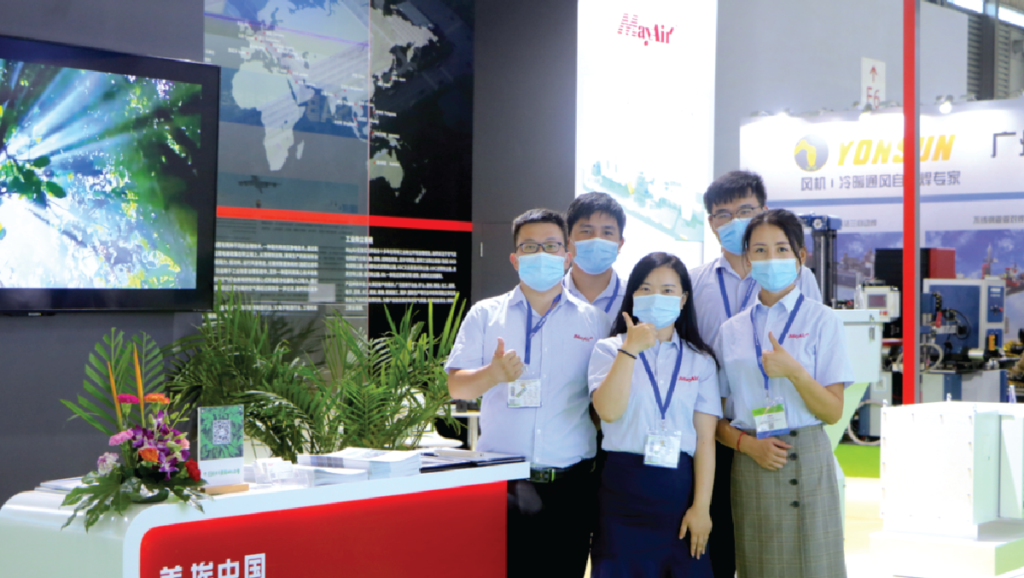
Shanghai, 13-15 August 2020 – The 21st China World Expo was successfully concluded at the Shanghai New International Expo Center. This is a comprehensive exhibition with the core of promoting the comprehensive management of environmental protection, innovative technology, and the coordinated development of the entire industry chain. Although the epidemic has been effectively controlled, during the exhibition, everyone still has a strong sense of prevention. Wearing masks when enter and getting out from the exhibition hall. Also consciously measure body temperature when entering the exhibition hall. The most eye-catching exhibits in this exhibition are the “centrifugal oil mist purifier” and “zeolite runner”, which not only enriches the existing product chain, but also greatly enhances the comprehensive competition of products Power, and of course, the core unit of air filtration, which is a mature supporting product of MayAir, has been unanimously recognized and praised by new and old customers on the spot. Most popular product during this exhibition, zeolite runners are combined with other equipment to treat volatile organic waste gas VOCs. The working principle of zeolite runners:-adsorption-desorption-cooling; ingenious design and precise services have attracted many Chinese and foreign Merchants stopped to watch the consultation and negotiation, including many difficult questions about the zeolite runner and how to purify the environment. After the on-site technical guidance and analysis, they were satisfied and some reached the purchase intention. MayAir is committed to the improvement of global air quality, strives to promote the development of the purification industry, encourages and advocates environmental protection, advocates energy conservation and emission reduction, and shoulders a heavy responsibility for the social environmental protection cause. In the future, on the road to air purification, MayAir strives to do better!
The 21st China Hospital Construction Conference 2020
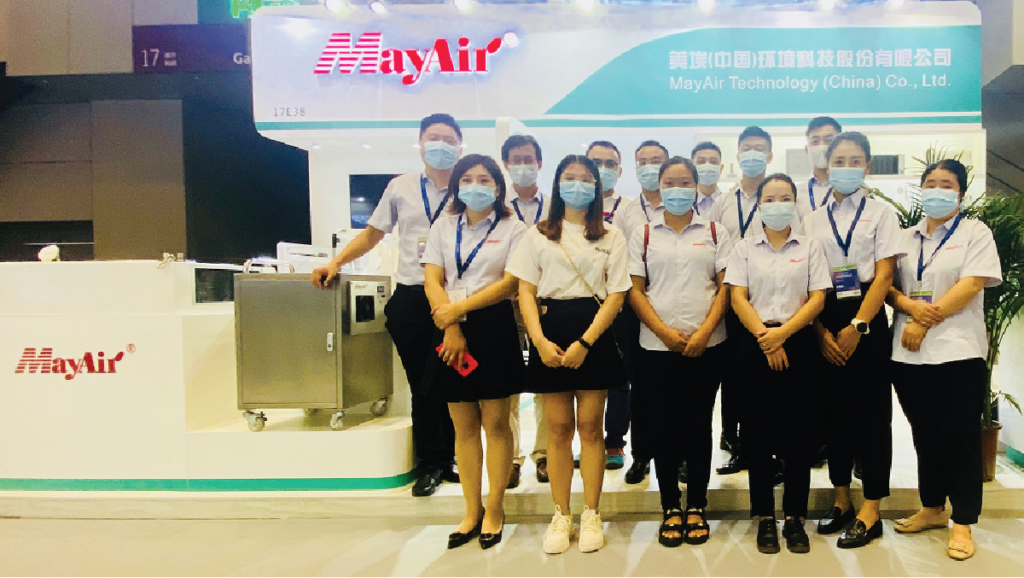
Shen Zhen, 21 September 2020 – The 21st National Hospital Construction Conference and China International Hospital Construction, Equipment and Management Exhibition came to an end in Shenzhen International Convention and Exhibition Center (Bao’an District). With the theme of “Intelligent Integration · Diversified Development-Active Health Hospital Transformation and Construction Innovation”, this conference was jointly organized by Zhuyitai, China Medical Equipment Association Hospital Construction and Equipment Branch and a number of authoritative institutions. Nearly 10,000 professionals Visitors will participate online and offline at the same time. As an exhibitor of this exhibition, MayAir Technology (China) Co., Ltd. concentrated on displaying its overall solutions and innovative practices in the field of medical purification. At the same time, new products aimed at the negative pressure isolation area of the hospital debuted at the exhibition site, attracting many guests to stop and exchange, click on the video to learn about them. With the display of advanced intelligent equipment and professional technical explanations, MayAir has won unanimous praise from exhibitors from all over the world. As a place to treat patients and save people, hospitals are the places with the most stringent requirements for environmental purification in civil buildings. MayAir has been committed to air purification for 20 years, and has different purification products for different functional areas of the hospital.
MayAir Contributes Air Purifier To Combat COVID-19
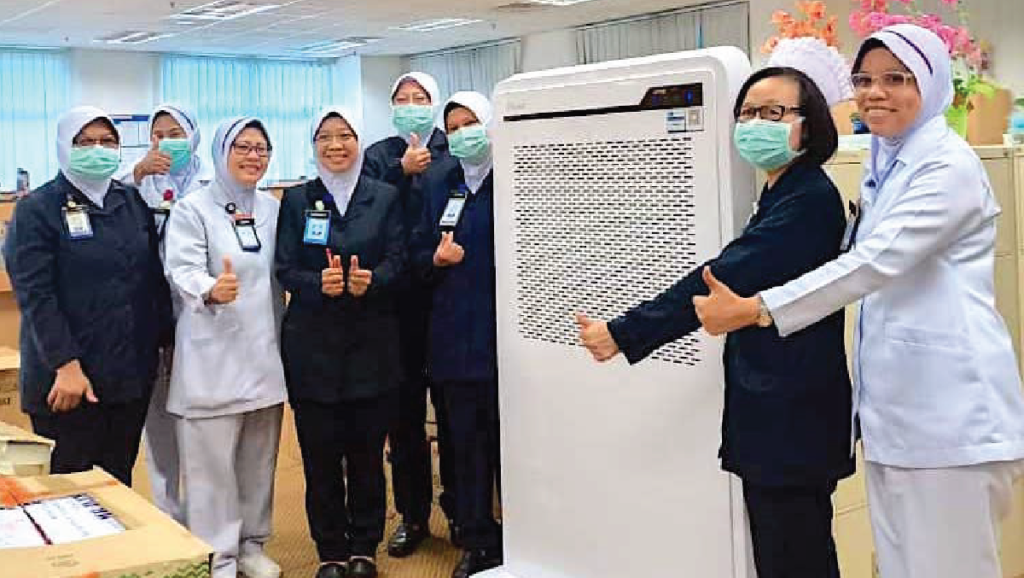
Kuala Lumpur, 9 April 2020 – In the midst of the Movement Control Order and COVID-19 outbreak currently concerning the nation, various organisations have approached to battle this pandemic, including Malaysia’s homegrown international and leading air filtration manufacturer, MayAir Group. Striving for the betterment of the nation and to prevent the spread of these infectious diseases in hospitals, MayAir Group stepped forward to contribute a series of air purifiers including D-Breath 5 and Air Purifier 401 worth up to RM100,000 to Hospital Sungai Buloh, Hospital Kuala Lumpur and Hospital Kluang, Johor. Ir Yap Wee Keong, Group Chief Executive Officer of MayAir Group elaborated that these air purifiers are able to specifically filter aerosolized particles or air droplets that contained bacteria and viruses. “D-Breath 5 (certified with the AHAM seal and CE marked) comes with a HEPA filter that assists in filtering aerosolized particles or air droplets containing bacteria and virus, which is why we specifically allocated these purifiers for hospitals treating mainly COVID-19. Apart from the removal of microbes, this filter made from ultrafine particle filtration media is also capable of removing any particles that are larger than 0.3µm with minimum 99.99% efficiency,” said Ir Yap. “We know the sacrifices that the frontliners are facing every day, as such MayAir is also doing their best to provide the necessary to reduce the risk of frontliners getting infected, while ensuring them that they are not left behind and we care for their health and safety as well.” Being one of the established pioneers of air purification technology in China, MayAir Technology (China) Co. Ltd., the sister company of MayAir Group likewise extended their support by donating a series of air purifiers and air filters to various hospitals in China when the outbreak first arose in January 2020, namely Huoshenshan Hospital, Leishenshan Hospital, Jinyintan Hospital, Xiehe Hospital, Asia Heart Hospital, Huangpi County Hospital of Traditional Chinese Medicine that are located in Wuhan; Shanghai HuaShan Hospital, Ninth People’s Hospital, No.10 People’s Hospital and many others. “It is our responsibility to assist as best we can to those who are in need of the assistance in order to combat Covid-19, particularly frontliners for all their sacrifices throughout the past few months,” concluded Ir Yap.